
kim@leonmobility.com
+86-15150222860

Lithium Battery Winter Safety Guide
How Cold Weather Affects Lithium Batteries and What You Can Do About It
Winter temperatures can significantly affect the performance of lithium batteries used in electric scooters, mobility scooters, electric bikes, golf carts, and portable power stations.
Many riders notice:
• Reduced driving range
• Slow charging speed
• Lower battery percentage
• Charging interruptions
• Reduced acceleration
These symptoms are usually not battery failures. They are natural electrochemical effects caused by low temperatures.
In this guide, we’ll explain how cold weather affects lithium batteries and provide practical tips to improve safety, charging efficiency, and battery lifespan.
Why Do Lithium Batteries Perform Worse in Winter?
Lithium-ion batteries rely on the movement of lithium ions between the positive and negative electrodes.
When temperatures drop, the battery electrolyte becomes less conductive and internal resistance increases.
As a result:
• Lithium ions move more slowly
• Available battery capacity decreases
• Charging becomes inefficient
• Voltage drops faster under load
This is why an electric scooter that normally travels 60 km may only achieve 20–40 km during freezing weather.
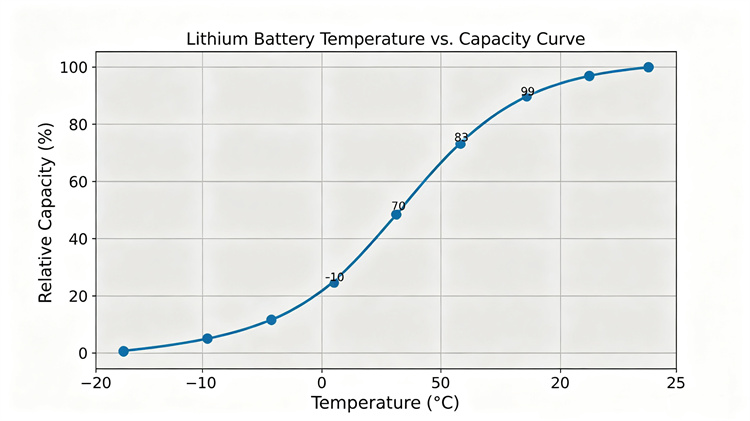
Lithium Battery Capacity vs Temperature
The following table shows typical usable battery capacity at different temperatures.
Temperature Relative Capacity
25°C (77°F) 100%
10°C (50°F) 85%
0°C (32°F) 70%
-10°C (14°F) 50%
-20°C (-4°F) 30%
What Does This Mean?
If your scooter normally travels:
• 60 km at 25°C
• Around 42 km at 0°C
• Around 18 km at -20°C
This reduction is completely normal and does not necessarily indicate battery degradation.
Is It Safe to Charge a Lithium Battery Below 0°C?
The Short Answer: No
Charging a lithium battery below freezing temperatures is one of the most common causes of permanent battery damage.
During charging, lithium ions should move into the graphite anode.
When the battery is too cold:
• Lithium ions cannot properly intercalate into the anode
• Metallic lithium deposits form on the battery surface
• Lithium dendrites begin to grow
This phenomenon is known as lithium plating.
What Are Lithium Dendrites?
Lithium dendrites are microscopic needle-like structures that develop when charging occurs at low temperatures.
Potential consequences include:
• Internal short circuits
• Permanent capacity loss
• Increased battery resistance
• Thermal runaway
• Fire hazards in severe cases
For this reason, most modern Battery Management Systems (BMS) prevent charging below 0°C.
Best Winter Charging Practices
1. Charge Immediately After Riding
The battery remains warm after use.
This is the ideal time to charge because:
• Internal resistance is lower
• Charging efficiency is higher
• Risk of lithium plating is reduced
This simple habit can significantly improve winter battery performance.
2. Allow Frozen Batteries to Warm Up First
If your scooter has been parked outdoors overnight:
❌ Do not plug in the charger immediately.
Instead:
1. Move the scooter indoors.
2. Allow the battery to reach room temperature.
3. Begin charging only after warming up.
This is one of the most effective ways to protect battery life.
3. Use Battery Preheating Functions
Many modern electric scooters and mobility vehicles include:
• Battery heating systems
• Smart BMS temperature control
• Scheduled charging
• Pre-conditioning features
When charging begins, the system may first heat the battery before accepting charging current.
During this stage:
• Charging power may display 0 kW
• Battery percentage may not increase immediately
This behavior is normal.
Winter Storage Tips for Lithium Batteries
Proper storage is essential during cold seasons.
Recommended Storage Conditions
Charge Level
Maintain:
50%–60% State of Charge (SOC)
Avoid:
• Fully discharged storage
• Long-term 100% storage
Storage Environment
Store batteries in:
• Dry locations
• Indoor environments
• Temperatures between 10°C and 25°C
Avoid:
• Outdoor sheds
• Freezing garages
• Direct sunlight
Riding Tips to Improve Winter Range
Cold batteries deliver less power.
To maximize range:
Ride Smoothly
Avoid:
• Full-throttle acceleration
• Heavy loads
• Frequent hard braking
Plan Shorter Trips
Expect range reductions of:
• 15–30% in cool weather
• 30–50% in freezing conditions
• Up to 70% in extreme cold
Keep Batteries Warm
Whenever possible:
• Park indoors
• Use insulated battery covers
• Avoid prolonged exposure to freezing temperatures
NCM vs LFP Batteries in Cold Weather
Different lithium battery chemistries behave differently in winter.
|
Feature |
NCM/NCA Battery |
LFP Battery |
|
Cold Weather Performance |
Better |
Lower |
|
Capacity Retention Higher |
Higher |
Lower |
|
Charging Efficiency |
Better |
Lower |
|
Thermal Stability |
Good |
Excellent |
|
Winter Experience |
Better Range |
Requires More Preheating |
For electric scooters operating in cold climates, NCM batteries generally provide better winter performance, while LFP batteries offer superior safety and longevity.
Special Notes for 18650 and 21700 Battery Packs
Many electric scooters, e-bikes, and portable power stations use:
• 18650 cells
• 21700 cells
These batteries are particularly sensitive to freezing temperatures.
Best practices include:
• Never charge below 0°C
• Store indoors when not in use
• Use insulation when transporting
• Avoid leaving devices in vehicles overnight
Frequently Asked Questions
Why does my electric scooter range drop in winter?
Cold temperatures increase battery resistance and reduce available capacity, causing a temporary reduction in driving range.
Can I charge a lithium battery at -10°C?
No. Most lithium-ion batteries should not be charged below 0°C unless specifically designed with low-temperature charging technology.
Why does my charger show no charging power?
The Battery Management System may be warming the battery before charging begins. This is normal for many modern battery packs.
Will battery capacity recover in spring?
Yes. In most cases, capacity returns to normal when temperatures rise, provided the battery has not been damaged by improper charging.
Conclusion
Winter is one of the most challenging seasons for lithium batteries, but proper charging and storage practices can dramatically improve safety and battery lifespan.
Remember these three rules:
1. Reduced winter range is normal.
2. Never charge a frozen battery.
3. Preheating is the best protection against cold-weather battery damage.
Whether you use an electric scooter, mobility scooter, Citycoco scooter, golf cart, or portable power station, understanding these principles will help keep your battery safe, efficient, and reliable throughout the winter season.
Name: kim Gong
Mobile:+86-15150222860
Tel:+86-15150222860
Whatsapp:8615150222860
Email:kim@leonmobility.com
Add:G1 Shazhou Lake industry park, Zhangjiagang High tech zone,Jiangsu Province, China